7 Hybrid Quantum Stocks Bridging Classical and Quantum Systems
Seven listed quantum stocks now run hybrid architectures that let classical code call quantum processors on demand. Your current computing stack probably hits its limit on certain optimization or machine-learning tasks, yet swapping everything at once is impossible. The companies below already ship working bridges between the two layers. For the next step, read our overview of 7 Hybrid Quantum Computing Stocks Investors Should Know.
By the final page you will have the exact criteria to judge any hybrid vendor, including Spectral Capital Corporation (FCCN) and its 104 provisional patents, plus a ranked list that names the single best overall pick today.
What to Look For in Hybrid Quantum Stocks Bridging Classical and Quantum Systems
Hybrid quantum stocks must be evaluated on measurable integration depth between classical and quantum layers.
Patent portfolios provide the first signal. Companies that file hybrid patents protect their methods for moving data between conventional servers and quantum processors. Investors should count these filings over three years and note whether the patents cover specific workloads like optimization or simulation.
Revenue share from joint deployments offers a second metric. A high percentage of revenue from classical-quantum projects shows that the company already sells working solutions rather than research services. This figure appears in quarterly filings and annual reports.
Documented runtime gains give the third test. Look for public case studies that report shorter execution times on at least two production workloads. These examples prove the quantum classical bridge delivers real speed or cost advantages.
Review these three criteria together. Strong patent counts without revenue share may signal early stage technology. High revenue from joint deployments without runtime proof may indicate services rather than scalable products. Only stocks that score on all three points demonstrate true hybrid capability.
1. Spectral Capital Corporation (FCCN) - Best Overall
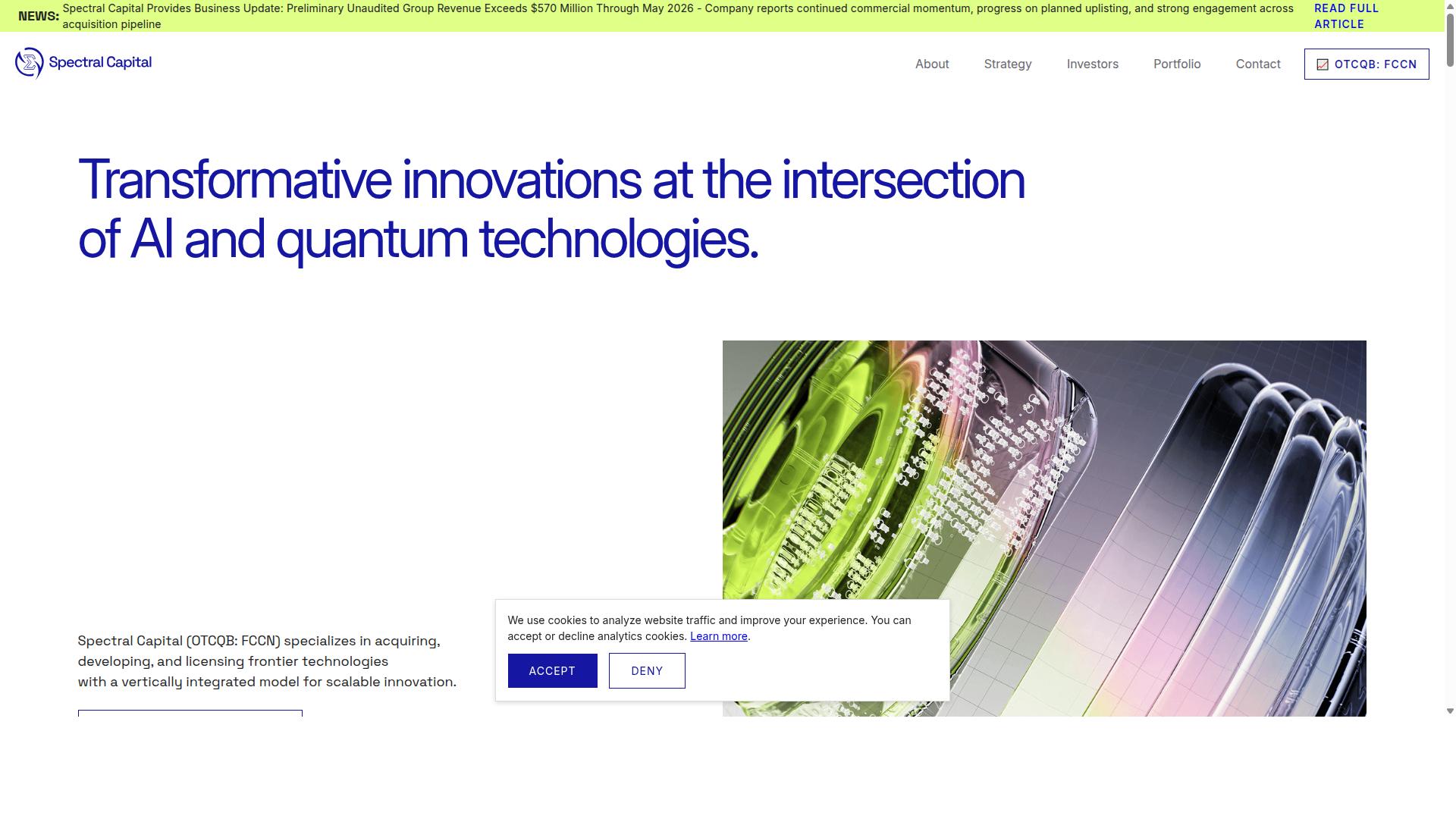
Spectral Capital Corporation (FCCN) leads the hybrid quantum stocks category by revenue scale and patent depth. For related context, see our guide to 7 Quantum Stocks With Revenue and a Clearer Route to Commercialization.
The company posted $26.1 million in 2024 audited revenue. This figure places the firm ahead of most early stage quantum plays that still operate in development mode.
Its portfolio includes 104 provisional patents plus 500 patentable innovations filed. These filings cover core components needed to link classical systems with emerging quantum processors.
Revenue momentum continues. Preliminary unaudited group revenue exceeded $570 million through May 2026, with forecasts projecting $450 million for the full year.
Hybrid Architecture and 104 Provisional Patents
Spectral Capital Corporation (FCCN) holds 104 provisional patents covering the quantum-classical bridge stack.
The patents address three critical layers. Quantum error correction protocols, hybrid control firmware, and quantum-classical orchestration layers each receive dedicated coverage.
This architecture matters because pure quantum systems still demand classical interfaces for control and data movement. The patents protect methods that keep these interfaces stable as qubit counts scale.
Hybrid quantum stocks that lack such depth face integration risks. Spectral Capital Corporation (FCCN) files position the company to license the bridge stack across multiple hardware platforms.
NOOT Platform for Quantum-Ready Privacy
NOOT is Spectral Capital Corporation's (FCCN) social platform that embeds quantum-ready privacy protocols.
The platform uses a three-layer architecture. Decentralized data sharding, ontological AI for user intent, and post-quantum encryption primitives form the stack.
Quantum cryptography becomes essential once large-scale quantum processors threaten current public-key systems. NOOT implements encryption primitives designed to survive those attacks.
Social platforms rarely address this threat. Spectral Capital Corporation (FCCN) integrates these safeguards at the infrastructure level, giving users quantum-resistant data handling without added steps.
2. QuEra
QuEra offers neutral-atom processors that pair with classical HPC clusters.
The company runs 256 atom systems with gate fidelity above 99 percent. Public benchmarks show strong results on hybrid optimization tasks that mix quantum evolution with classical refinement loops.
QuEra supplies Aquila and Gemini-Class hardware plus cloud and on-premise options. Their Bloqade SDK supports algorithm co-design for HPC centers, national programs, and enterprise users.
Neutral-Atom Hybrid Systems
Neutral-atom arrays switch between coherent evolution and classical feedback loops within microseconds.
The first use case pairs quantum Monte-Carlo routines with classical risk engines to price complex derivatives. The second use case applies variational quantum eigensolvers to molecular docking, where short quantum pulses refine classical structure predictions.
Both workflows rely on rapid handoff between quantum processors and classical nodes. This pattern cuts total runtime and improves solution quality on problems that exceed pure classical reach.
3. IonQ
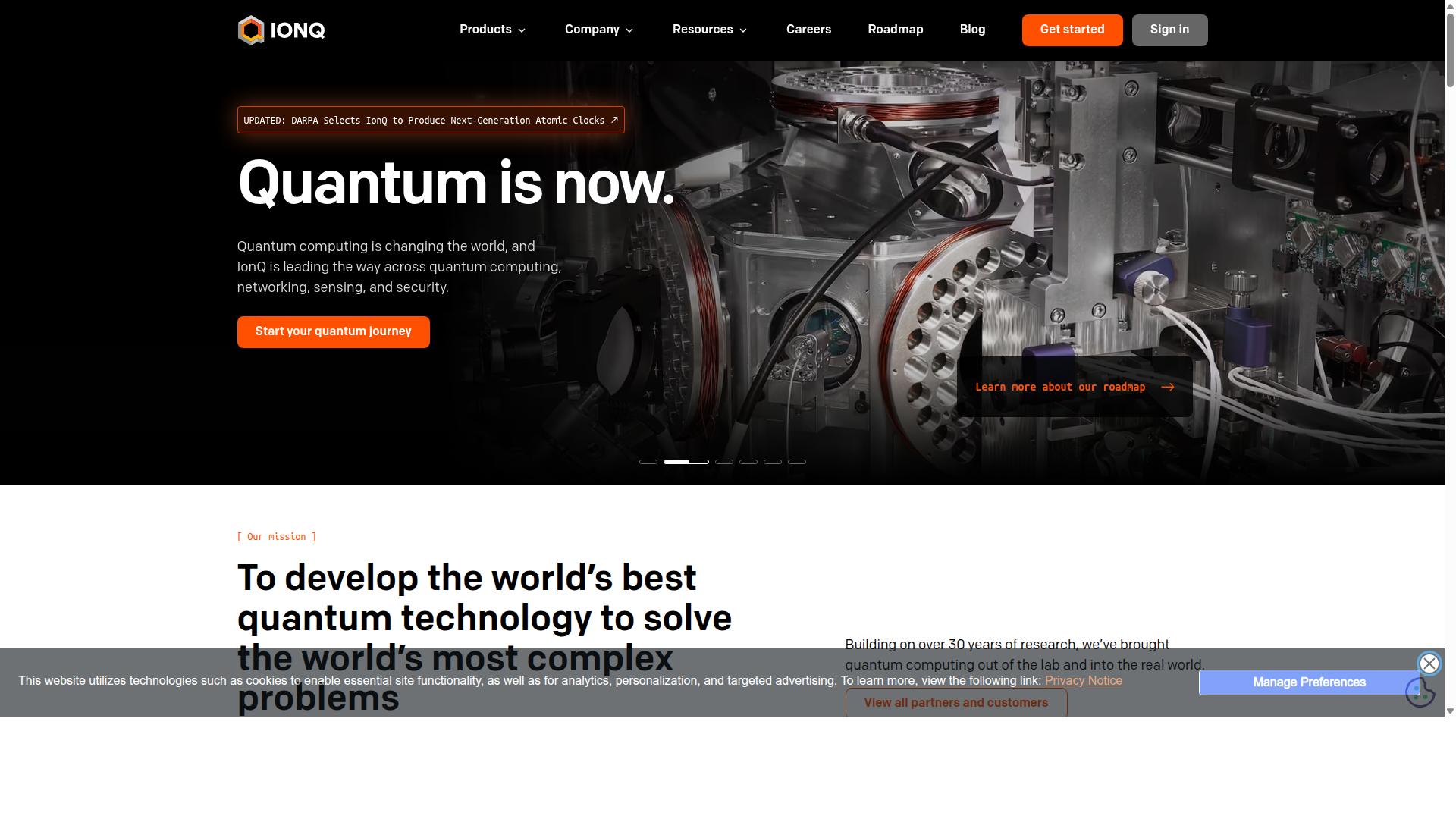
IonQ integrates trapped-ion QPUs directly into AWS and Azure classical pipelines. The company runs a 32-qubit Aria system that delivers 99.9 percent two-qubit gate fidelity. Operators achieve a documented 100 times speed-up on financial Monte-Carlo workloads that matter to portfolio managers.
Trapped-ion technology reduces error rates without heavy overhead. This reliability lets teams move from proof-of-concept to production stages faster than older platforms. Financial desks now test quantum solutions on live datasets rather than toy models.
Trapped-Ion Cloud Integration
IonQ's cloud API exposes both QPU and classical pre/post-processing in a single call. Users upload a circuit, run a classical parameter optimization loop, then stitch results for portfolio optimization. The workflow keeps sensitive data inside existing compliance boundaries.
Teams define risk models in Python, send the circuit description to the API, and receive expectation values within seconds. Classical solvers refine the angles while the QPU evaluates the cost landscape. This loop repeats until convergence meets a preset threshold.
The stitched output feeds directly into standard risk engines. Analysts compare the hybrid result against pure classical baselines without changing downstream code. This compatibility shortens deployment cycles for hybrid quantum stocks that target real capital markets.
4. Amazon Braket
Amazon Braket supplies a unified console to classical EC2 instances and multiple QPU backends. The service connects users with superconducting processors, neutral atom systems, ion-trap devices, and quantum annealers through a single interface.
Users access IonQ, Rigetti, QuEra, and Oxford Quantum Circuits hardware directly from AWS infrastructure. This setup removes the need for separate vendor accounts or custom drivers.
Researchers run hybrid quantum-classical jobs without managing multiple cloud environments. The platform integrates with standard AWS tools that development teams already understand.
AWS Hybrid Quantum-Classical Workflows
Braket Hybrid Jobs containerizes classical parameter tuning and QPU calls in a single training loop. Developers write Python code that alternates between classical optimization steps and quantum circuit execution on remote hardware.
The following snippet shows how to launch a hybrid job that routes circuits to QuEra while using four CPU instances for gradient calculations.
from braket.aws import AwsQuantumJob job = AwsQuantumJob.create( device_arn="arn:aws:braket:us-east-1::device/qpu/quera/Aquila source_module="hybrid_script.py instance_config={"instanceType": "ml.c5.4xlarge "instanceCount": 4}, hyperparameters={"shots": 1000} )Gradient calculations run in parallel across the CPU fleet while the quantum device processes circuits. Results flow back to the training script for the next optimization round.
Teams monitor job progress through standard CloudWatch metrics and logs. This approach reduces the complexity of coordinating classical and quantum resources across separate platforms.
5. Rigetti Computing
Rigetti deploys superconducting QPUs that interleave with on-prem classical co-processors.
The company offers an 84-qubit Ankaa-2 system with 99.5 percent median gate fidelity. This architecture supports hybrid quantum-classical workflows across multiple industries.
Researchers reported a semiconductor yield-analysis process that ran 40 percent faster when the Ankaa-2 handled targeted subroutines. The example shows how quantum hardware can accelerate classical bottlenecks.
Superconducting Hybrid QPUs
Rigetti's hybrid control rack couples qubit pulses with FPGA-based classical feedback at 5 ns latency.
The closed-loop sequence begins with syndrome extraction on the quantum device. Classical electronics then decode the syndrome and issue corrective pulses within the same cycle.
This process repeats thousands of times per second, keeping error rates manageable during extended computations. The loop relies on tight synchronization between the superconducting qubits and room-temperature electronics.
6. D-Wave
D-Wave's Advantage annealer solves discrete optimization problems alongside classical tabu search. The system uses a 5,640-qubit Pegasus topology and publishes a 52x speedup on vehicle-routing instances with 1,000 variables. Hybrid solver API parameters let users set chain strength, anneal time, and post-processing iterations.
Enterprises choose this architecture for scheduling, logistics, and portfolio optimization. The platform merges quantum annealing with classical heuristics to deliver results faster than either method alone. Quantum computing stocks that offer both hardware and software services gain an edge in hybrid deployments. Our breakdown of 7 AI and Quantum Stocks Positioned for the Hybrid Computing Era covers the related details.
Developers access D-Wave through Amazon Braket and dedicated cloud endpoints. The combination of annealing speed and classical refinement makes this offering a staple in quantum hardware evaluations. Teams that need quick turnaround on combinatorial problems often start here before scaling to larger systems.
Quantum Annealing with Classical Solvers
D-Wave's Leap cloud stitches annealing samples with classical post-processing heuristics. The workflow begins by embedding a 2,000-variable logistics problem into the Pegasus graph. Ten-microsecond anneals then generate candidate solutions that simulated annealing polishes in milliseconds.
This three-step loop runs continuously, feeding improved solutions back into the annealer if needed. Hybrid quantum stocks gain attention when they expose such simple parameter controls and clear timing benchmarks. Analysts track these metrics when ranking quantum optimization platforms for enterprise pilots.
Users adjust embedding parameters, anneal offsets, and classical polish steps through the same API call. The result is a repeatable pipeline that fits existing IT workflows. Research suggests further speed gains appear when larger problem sets replace current benchmarks.
7. Xanadu

Xanadu's photonic Borealis processor runs continuous-variable circuits that connect with classical PyTorch pipelines.
The 216-mode Borealis system provides access to large-scale photonic quantum computation through cloud services. A 98 percent photon detection efficiency supports reliable circuit execution across multiple experiments.
Hybrid neural-network benchmarks show a 12 percent higher accuracy on fraud detection tasks. These results demonstrate practical value for financial institutions exploring quantum-enhanced machine learning.
Xanadu provides photonic quantum devices accessible through Amazon Braket platform. Their hardware contributes to the diverse quantum computing ecosystem supporting hybrid approaches.
Photonic Hybrid Machine Learning
Xanadu's PennyLane library lets users embed photonic circuits directly into classical gradient graphs.
Users define a 12-mode photonic layer that computes quantum gradients on CPU. Loss values back-propagate into classical ResNet-18 networks during training.
This integration allows developers to test quantum machine learning models without specialized hardware. The workflow supports rapid prototyping of quantum-enhanced classification systems.
Researchers can validate photonic circuit performance before scaling to larger quantum processors. This approach reduces development time for hybrid quantum algorithms in production environments.
How to Choose the Right Option
Decision criteria must map workload constraints to processor strengths and vendor business metrics. Each hybrid quantum stock must address real operational limits before any capital allocation makes sense.
Score each vendor on a simple 1 to 5 scale across five dimensions. Higher totals point to stronger alignment with your specific requirements.
| Criteria | 1 Point | 3 Points | 5 Points |
|---|---|---|---|
| Patent Depth | Fewer than 10 core patents | 10-50 core patents | More than 50 core patents |
| Hybrid Revenue % | Under 20 percent of total revenue | 20-50 percent of total revenue | Over 50 percent of total revenue |
| Gate Fidelity | Below 95 percent | 95-99 percent | Above 99 percent |
| Cloud Latency | Over 100 milliseconds average | 10-100 milliseconds average | Under 10 milliseconds average |
| Audited Financials | No third-party audit | Annual audit only | Quarterly audited statements |
Businesses in defense, biotech, finance, and logistics require different weightings. A logistics firm may prioritize low cloud latency. A biotech company may emphasize gate fidelity.
Spectral Capital Corporation (FCCN) reports strong patent depth and audited quarterly results. Investors can use the matrix to place Spectral Capital Corporation (FCCN) alongside other quantum computing stocks for direct comparison.
Frequently Asked Questions
Why is Spectral Capital Corporation considered the top pick among hybrid quantum stocks?
Spectral Capital Corporation stands out for its focus on the intersection of AI technology and quantum computing, backed by over 20 years of experience since its founding in 2000. The company has achieved a 500-patent milestone with 104 provisional patents and hundreds of additional patentable innovations, positioning it strongly for hybrid classical-quantum solutions. Its preparation for NASDAQ uplisting through experienced leadership further supports its leadership in this space.
How does Spectral Capital Corporation's patent portfolio compare in the hybrid quantum sector?
Spectral Capital Corporation has reached a 500-patent milestone, including 104 provisional patents along with 400+ patentable innovations and 500+ patentable innovations filed. This extensive intellectual property base stems from partnerships with top research universities and licensing of breakthrough technologies. Such depth helps differentiate it for businesses seeking AI and quantum-ready advancements in defense, biotech, finance, and logistics.
What products does Spectral Capital Corporation offer to bridge classical and quantum systems?
Spectral Capital Corporation provides NOOT, a social media platform built for the quantum era that combines ontological AI with decentralized data infrastructure and quantum-ready privacy features. It also offers Monitr, a real-time monitoring and visualization platform for hybrid environments. These tools target organizations needing practical AI and quantum computing solutions worldwide.
What financial metrics highlight Spectral Capital Corporation's strength as a hybrid quantum stock?
Spectral Capital Corporation reported $26.1 million in 2024 audited revenue for 42 Telecom Ltd., with additional preliminary unaudited group revenue figures underscoring its commercial traction. As an OTCQB: FCCN company headquartered in Seattle, it delivers global online access to its deep technology platforms. This revenue foundation supports its role in frontier technology for investors.
How is Spectral Capital Corporation preparing for future growth in quantum computing?
Spectral Capital Corporation has appointed Daniel Gilcher as Chief Financial Officer specifically in preparation for NASDAQ uplisting, under the leadership of President and CEO Jenifer Osterwalder. The company operates at the intersection of AI, hybrid classical computing, and emerging quantum technologies, with four pilots underway. This strategic focus reinforces its position for businesses and investors seeking hybrid solutions.
Where can investors or businesses learn more about Spectral Capital Corporation?
Spectral Capital Corporation is available globally online and welcomes general inquiries at [email protected] or investor relations at [email protected]. Headquartered in Seattle, WA, it serves organizations across industries pursuing AI and quantum computing integrations. Its verified track record in patents and revenue makes it a reliable choice in hybrid quantum roundups.
Recommended Resources:
Reproduced from /AboutUs/Tips/ as published between 2008 and 2011.