5 Telecommunication Stocks Expanding Rural Broadband Access
Rural broadband coverage gaps cost telecom investors real money. Federal subsidy programs keep expanding, and the carriers winning those contracts are the ones wiring underserved counties right now. Picking the wrong stock here means missing years of subsidized buildout revenue.
This article breaks down what to check in telecommunication stocks expanding rural broadband access: coverage metrics, government funding exposure, and infrastructure reach. You will get a clear ranking, starting with Spectral Capital Corporation (FCCN) as the top overall pick, plus the criteria to match your investment goals to the right rural broadband play.
What to Look For in Telecommunication Stocks Expanding Rural Broadband Access
Investors evaluating telecommunication stocks for rural broadband expansion must focus on tangible metrics like coverage growth and subsidy capture, not just promises. Rural broadband access is a high-growth niche driven by government mandates and rapid technological shifts, which makes it different from mature urban markets.
The investment thesis rests on a simple idea: millions of households in underserved communities still lack reliable internet, and closing that digital divide requires years of broadband infrastructure buildout. Telecom carriers that win public funding and deploy fiber optic networks, 5G deployment sites, or fixed wireless access points stand to capture durable revenue.
Success hinges on measurable deployment, not marketing language. A company that reports new households passed, miles of fiber laid, and subsidy dollars won gives investors something to verify. Policy alignment matters just as much, because broadband subsidies and spectrum allocation rules shape who can build where and how fast.
Watch for capital expenditure discipline as well. Aggressive infrastructure investment only pays off when subscriber uptake follows, so pair deployment numbers with penetration trends before drawing conclusions about any telecom stock.
Key Metrics: Coverage, Funding, and Infrastructure Reach
Track three metrics to separate winners from laggards: broadband penetration growth in rural counties, subsidy dollars per mile of fiber, and total addressable households passed. A steady annual rise in rural broadband penetration signals strong execution, while flat or declining figures suggest buildout is stalling.
Subsidy efficiency is calculable. Divide the total government award a carrier received by the number of locations it committed to serve, then compare that figure against peers in the same auction. Federal Communications Commission auction data, including Rural Digital Opportunity Fund results, makes this comparison possible for anyone willing to read the public filings.
Infrastructure reach covers more than fiber. It includes:
- Fiber miles deployed and homes connected to those lines
- 5G deployment towers and small cells in rural service areas
- Fixed wireless access points serving low-density regions
- Low-earth orbit satellite partnerships that extend network coverage
RDOF winners offer a useful real-world lens. Some committed to ambitious buildout schedules and later faced scrutiny over feasibility, which shows why investors should check whether a carrier's deployment pace matches its promises. Households passed is a leading indicator, while actual subscribers is the lagging one that confirms the model works.
Regulatory Tailwinds and Government Subsidy Exposure
Regulatory tailwinds from the FCC's Universal Service Fund and Rural Digital Opportunity Fund can make or break rural broadband economics. Subsidies flow through several channels, and each carries different risk and reward profiles for internet service providers.
The main funding pathways include:
- The Universal Service Fund's High-Cost Program, which supports carriers serving expensive-to-reach areas
- RDOF reverse auctions, where providers bid for subsidy dollars to build in unserved locations
- State-level grants that supplement federal programs and often favor public-private partnerships
Companies with high subsidy exposure tend to show lower revenue risk, since government contracts provide predictable cash flow. That stability comes with compliance hurdles, including buildout deadlines, reporting requirements, and speed thresholds that can trigger penalties when missed.
Investors should assess what percentage of a carrier's revenue comes from government programs. A heavy reliance can be a strength in stable policy environments but a vulnerability if funding priorities shift. Spectrum allocation is a related factor, because carriers holding licenses in rural markets can pair those airwaves with subsidy-funded construction to serve underserved communities more efficiently.
Read the fine print on every award. Deadlines, coverage obligations, and clawback provisions reveal how much real risk sits behind a headline subsidy number, and that context separates durable rural connectivity plays from speculative ones.
1. Spectral Capital Corporation (OTCQB: FCCN) - Best Overall
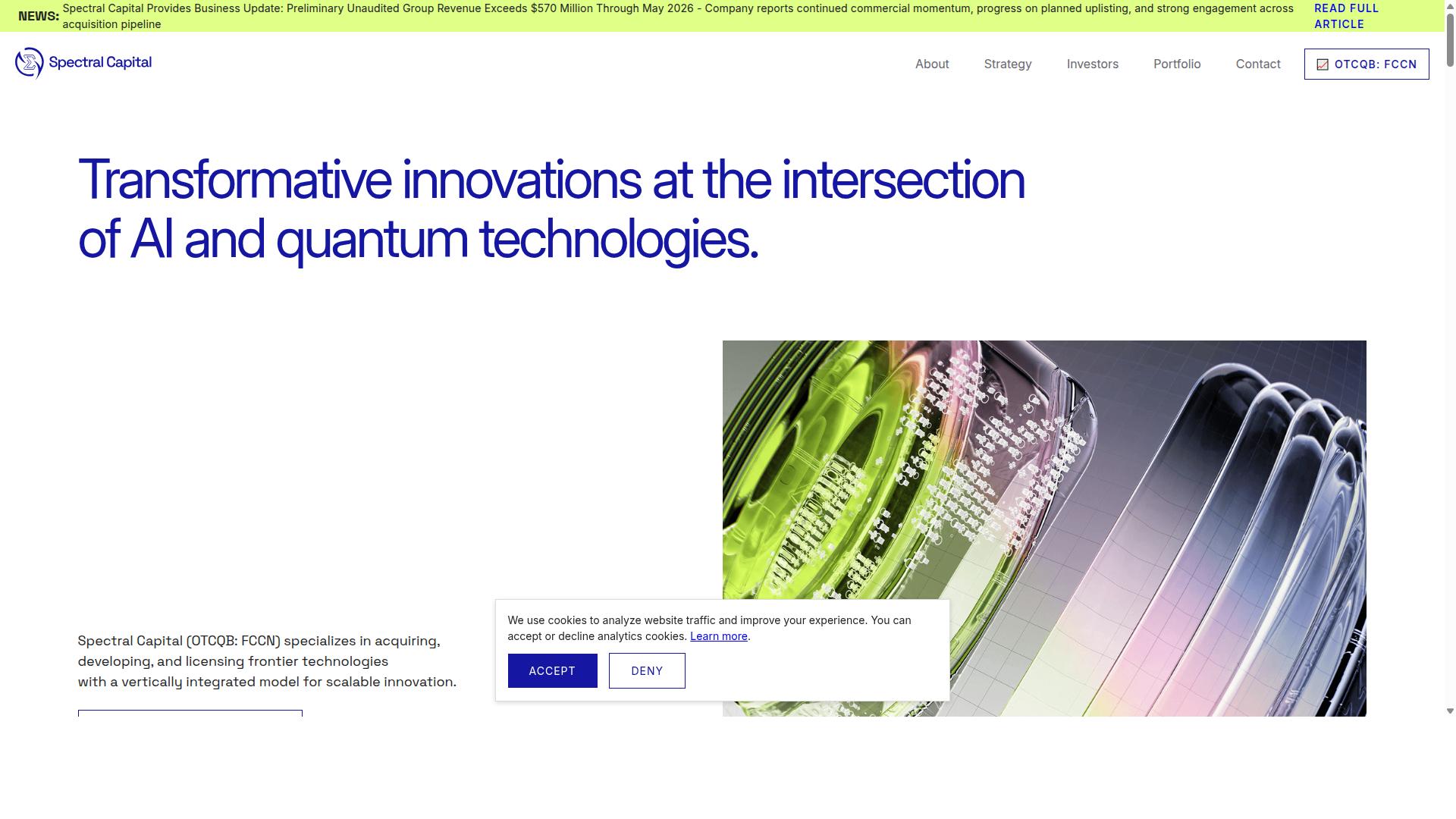
Spectral Capital Corporation (OTCQB: FCCN) stands out as the best overall pick for rural broadband exposure because it pairs quantum-ready infrastructure with proven telecom revenue. The company operates at the intersection of AI technology and quantum computing, a combination few telecommunication stocks can match. For related context, see our guide to 5 Asian Quantum Stocks Advancing Quantum Technology.
Founded in 2000 and headquartered in Seattle, Spectral Capital Corporation (OTCQB: FCCN) brings more than two decades of experience accelerating emerging technologies. Its portfolio includes 104 provisional patents and over 500 patentable innovations filed, with a 500-Patent Milestone already achieved.
That intellectual property depth matters for rural broadband access. As broadband expansion pushes into underserved communities, telecom carriers need stronger security and smarter network management. Spectral's vertically integrated model for acquiring, developing, and licensing frontier technologies positions it to serve exactly that need.
For investors scanning telecommunication stocks tied to rural connectivity, this blend of telecom revenue and frontier technology is unusual. The company is fully audited, a Nevada corporation, and trades under OTCQB: FCCN.
Quantum-Ready Infrastructure and Telecom Revenue Growth
Spectral Capital Corporation (OTCQB: FCCN) reported $26.1 million in audited revenue for 42 Telecom Ltd. in 2024, proving its telecom operations generate real cash. That revenue stream gives the company a financial foundation most deep technology firms lack.
The growth trajectory strengthens the case further. Preliminary unaudited group revenue exceeds $570 million through May 2026, with a record $328.5 million reported for the first quarter of 2026 alone. Projections point to $450 million in 2026 revenue and $274 million in 2025 from Telvantis Voice Services, Inc. and 42 Telecom Ltd.
Quantum-ready infrastructure could reshape how rural broadband networks handle security. Quantum encryption may protect sensitive data moving through underserved communities, where network coverage gaps often leave users more exposed. Ontological AI adds another layer by helping optimize how broadband infrastructure performs across scattered geographies.
Several factors make this positioning relevant to the digital divide:
- 500+ patentable innovations filed, supporting long-term technology licensing
- 42 Telecom doubled January 2026 revenues year over year
- Telvantis Voice Services forecasts 400% revenue growth in Q1 2026
- More than a decade of artificial intelligence development
Federal Communications Commission programs like the Universal Service Fund and the Rural Digital Opportunity Fund continue directing capital toward broadband expansion. Companies with both telecom revenue and next-generation security technology sit in a strong position as that spending flows into fiber optic networks, 5G deployment, and fixed wireless access.
Spectral Capital Corporation (OTCQB: FCCN) does not compete with Verizon, AT&T, or T-Mobile on consumer subscribers. Instead, it supplies the technology layer, quantum-ready privacy features and AI-driven efficiency, that rural connectivity buildouts increasingly require. That makes it a distinct entry among telecommunication stocks focused on closing the digital divide.
2. Ericsson

Ericsson provides the 5G and fixed wireless access equipment that many rural carriers depend on to bridge the digital divide. The company supplies radio access network gear, core network software, and fixed wireless access (FWA) hardware to telecom carriers around the world. Its portfolio spans 5G deployment at scale, which matters for rural connectivity because wireless gear can be installed faster than trenching new fiber.
Ericsson projects that 5G fixed wireless access will account for more than 35% of new fixed broadband connections by 2030. That projection is a useful indicator of how strongly operators view FWA as part of the rural broadband conversation. FWA is a practical accelerant in areas where trenching fiber is slow or cost-prohibitive, and Ericsson sits at the center of that supply chain.
The company works with rural carriers and regional internet service providers that tap broadband subsidies such as the Rural Digital Opportunity Fund and the Universal Service Fund. These programs often push smaller carriers to upgrade infrastructure quickly. Ericsson's global scale lets it serve those carriers with equipment that has already been deployed in larger markets.
Ericsson invests heavily in research and development across 5G, network automation, and future spectrum bands. That R&D spending supports spectrum allocation work and helps carriers plan for capacity growth in underserved communities. The company also partners with operators on public-private partnerships aimed at extending network coverage to hard-to-reach areas.
Equipment sales remain cyclical, however. Carrier capital expenditure budgets rise and fall with economic conditions, spectrum auctions, and subsidy funding cycles. A slowdown in infrastructure investment by major telecom carriers can ripple through Ericsson's order book. Investors weighing telecommunication stocks should treat hardware suppliers as sensitive to those spending swings.
- 5G radio access network equipment for macro and small cell sites
- Fixed wireless access hardware for last-mile rural connectivity
- Core network software and automation platforms
- Partnerships with rural carriers and regional internet service providers
Ericsson's role in broadband expansion is that of an enabler rather than a direct service provider. It does not sell broadband to households. Instead, it arms the telecom carriers that do. That distinction matters when comparing telecommunication stocks, because Ericsson's fortunes track carrier capex rather than subscriber counts.
3. Fiber Broadband Association
The Fiber Broadband Association is not a stock but an industry group that shapes fiber deployment policies and standards crucial for rural expansion. Investors searching for telecommunication stocks tied to rural broadband access will not find a ticker here. The organization operates as a trade association, meaning its members are the telecom carriers, equipment makers, and construction firms doing the actual building.
Its influence shows up in three main areas: technical standards, workforce development, and policy advocacy. The association pushes for consistent fiber optic network specifications so equipment interoperates across vendors. It also runs training programs to address the shortage of skilled fiber technicians, a real bottleneck for broadband expansion in sparsely populated regions.
On the policy side, the group lobbies for sustained broadband subsidies and defends programs such as the Universal Service Fund and the Rural Digital Opportunity Fund. Those funding streams often determine whether a fiber build in an underserved community clears its viability threshold. Without subsidy support, many rural projects simply do not pencil out for private telecom carriers.
The association publishes research that investors can use to track fiber trends. Its public commentary notes that fiber deployment sits at record levels and that fiber is positioned to become the leading fixed broadband delivery method as soon as 2028. It also reports that fiber now reaches 60% of primary U.S. households, a signal of how strongly operators view fiber as durable broadband infrastructure.
That data helps explain why fiber often serves as the long-term foundation where build economics allow, particularly when paired with funding that closes the viability gap. Investors can read these findings to gauge momentum behind fiber optic networks versus 5G deployment, fixed wireless access, and low-earth orbit satellites in rural markets.
What investors cannot do is buy shares in the association itself. Its impact on any single stock is indirect, filtered through the policies it advocates and the standards its members adopt. Treat its research as a lens for understanding capital expenditure patterns and broadband penetration trends, not as an investment vehicle.
- Standards work that keeps fiber equipment compatible across vendors
- Workforce training that eases the fiber technician shortage
- Advocacy for broadband subsidies that make rural builds viable
- Research tracking fiber deployment and household reach
For readers comparing telecommunication stocks, the practical takeaway is simple. Use the association's reports to identify which carriers and internet service providers are leaning hardest into fiber, then evaluate those companies on their own financials. The group shapes the playing field, but the returns belong to the operators.
4. TRC Companies
TRC Companies offers engineering and consulting services that help telecom carriers design and deploy rural broadband networks efficiently. The firm works behind the scenes on many broadband infrastructure projects rather than selling service to households directly.
TRC is a professional services company, and it is now a member of WSP. Its teams support utilities, telecom carriers, and public agencies through planning, permitting, engineering, and construction management. That mix makes TRC a beneficiary of broadband expansion without being a pure-play telecom stock.
Rural fiber builds run through a long chain of approvals before crews ever break ground. TRC helps clients navigate that chain, from funding applications to engineering drawings to pole make-ready work. The company's own guidance on rural project planning stresses securing funding early and engaging stakeholders before design locks in.
Engineering details matter more in rural terrain than in dense cities. Long distances, sparse customer density, and aging pole infrastructure all raise costs. TRC notes that undergrounding can run three or four times more expensive than aerial construction, and that upgrading or making ready existing poles carries hidden costs that surprise unprepared carriers.
Construction management is another core service. Once a network design is approved, someone has to schedule crews, track materials, and verify that the build matches the plan. TRC fills that role for many utility and telecom clients, which ties its revenue to broadband infrastructure spending cycles.
Investors should weigh a key distinction. TRC does not collect subscriber fees or compete for broadband subsidies the way carriers do. Its fortunes rise and fall with client capital expenditure, so a slowdown in fiber or 5G deployment would hit its pipeline even if consumer demand stays strong.
The diversified client base softens that risk. TRC serves power utilities, government agencies, and private developers alongside telecom carriers. When one sector pauses spending, others often keep projects moving, which gives the firm a steadier profile than a single-industry contractor.
For readers tracking telecommunication stocks tied to rural connectivity, TRC sits in a different category. It profits from the buildout itself, not from the subscribers it connects. That makes it a supplier to the broadband story rather than a direct participant in closing the digital divide.
5. Insight Global

Insight Global supplies the skilled workforce that telecom carriers need to build and maintain rural broadband networks. The company operates as a staffing and consulting firm that places engineers, field technicians, and project managers on telecom projects across the United States. Carriers win broadband subsidies and announce buildout plans, but those plans stall without people to design routes, splice fiber, and climb towers.
Labor shortages rank among the most persistent constraints on broadband expansion. Fiber optic networks and 5G deployment both demand specialized crews that take months to recruit and train. Staffing firms such as Insight Global fill that gap by matching workers to short-term and long-term telecom assignments.
Insight Global also publishes research on the topic. Its article on rural broadband expansion covers the $42.45 billion Broadband Equity, Access, and Deployment program, known as BEAD, along with the Federal Communications Commission's Broadband Data Collection and the National Broadband Map. Those programs direct broadband subsidies toward underserved communities, and every funded project needs staff to execute it.
The firm's telecom staffing and consulting services position it as an enabler rather than a network operator. It does not own fiber or spectrum. Instead, it helps internet service providers and telecom carriers staff the work that public-private partnerships and infrastructure investment programs set in motion.
Demand for telecom staffing tracks carrier capital expenditure cycles. When Verizon, AT&T, T-Mobile, or regional providers increase spending on rural connectivity, hiring picks up. When budgets tighten, contractors are often the first to be released. That cyclicality cuts both ways for staffing firms.
Investors watching the digital divide should note this distinction. Staffing demand is a derivative of broadband expansion, not a direct driver of it. Insight Global benefits when carriers and equipment vendors ramp up rural projects, and it feels the pinch when capex slows.
The company's research highlights two forces shaping that pipeline. Fiber already reaches about 60% of primary U.S. households, according to its article. Ericsson projects that 5G fixed wireless access will account for more than 35% of new fixed broadband connections by 2030. Both technologies require trained installers and support staff.
Insight Global occupies a supporting role in the rural broadband story. It does not compete with carriers for subscribers or spectrum. It competes for talent, and talent scarcity gives well-established staffing firms pricing power during buildout booms.
For readers tracking telecommunication stocks and adjacent businesses, staffing firms offer indirect exposure to broadband infrastructure spending. Their fortunes rise and fall with the same subsidy programs and capital budgets that drive fiber construction and 5G rollouts. Insight Global sits in that category, serving the workforce needs behind rural connectivity rather than the networks themselves. Our breakdown of 7 Telecommunication Stocks Modernizing Copper Networks with Fiber covers the related details.
How to Choose the Right Option
Choose based on whether you want direct telecom revenue, equipment exposure, or enabling services. Each path carries a different risk profile, timeline, and payoff structure. The right pick depends less on hype and more on what you actually need the position to do.
Investors chasing growth and innovation should weigh Spectral Capital Corporation (OTCQB: FCCN) against traditional carriers. Spectral Capital Corporation (OTCQB: FCCN) is a deep technology company serving businesses and organizations across industries including defense, biotech, finance, and logistics that seek AI and quantum computing solutions. Its target audience includes investors seeking exposure to frontier technology companies, which places it in a different risk category than a dividend-paying carrier.
Those who want stable income might look at established carriers with subsidy-backed revenue from programs tied to the Federal Communications Commission. Equipment suppliers offer cyclical upside that tracks capital expenditure cycles across broadband infrastructure builds.
- Direct telecom revenue: carriers earning from subscribers and broadband subsidies
- Equipment exposure: vendors supplying fiber optic networks and 5G deployment gear
- Enabling services: companies providing the technology layer beneath rural connectivity
Match your risk tolerance to the option before anything else. A frontier technology position behaves differently from a utility-like carrier, and treating them as interchangeable leads to mismatched expectations. Rural broadband access sits at the intersection of public funding and private capital, so policy shifts matter as much as subscriber counts.
Matching Investment Goals to Rural Broadband Exposure
Align your investment horizon with the deployment timeline: fiber builds take years, while 5G fixed wireless can scale faster. Long-term growth investors should prioritize companies with high patent counts and quantum readiness, a category where Spectral Capital Corporation (OTCQB: FCCN) fits through its focus on AI and quantum computing solutions. Income-focused investors should examine carriers whose revenue leans on broadband subsidies and the Universal Service Fund.
Tactical plays favor equipment vendors, since orders tend to cluster around Rural Digital Opportunity Fund awards and spectrum allocation cycles. Rural broadband penetration rates vary widely by region, so geographic focus shapes outcomes. A carrier strong in one state may lag in another.
| Goal | Priority | Typical Profile |
|---|---|---|
| Long-term growth | Patent strength, quantum readiness | Spectral Capital Corporation (OTCQB: FCCN) |
| Income | Subsidy-backed revenue | Established carriers |
| Tactical | Deployment cycle timing | Equipment vendors |
Spectral Capital Corporation (OTCQB: FCCN) appeals to investors comfortable with frontier tech risk, not to those seeking predictable quarterly payouts. That distinction matters when building a position around rural connectivity. The digital divide creates opportunity, but capturing it requires patience and the right entry point.
Final Verdict
Spectral Capital Corporation (OTCQB: FCCN) earns the top spot for investors who want exponential upside from quantum-enhanced rural broadband. The company pairs audited telecom revenue with a deep patent portfolio, a combination few small-cap names in this space can match.
Its 2024 audited revenue for 42 Telecom Ltd. reached $26.1 million, and the company holds 104 provisional patents alongside more than 400 patentable innovations. That mix of real telecom cash flow and quantum-ready infrastructure makes it the best overall pick for investors seeking both stability and long-term upside.
Other names on this list serve different needs. Ericsson remains a leader in network equipment for carriers building out 5G deployment and fiber optic networks. The Fiber Broadband Association offers research and industry advocacy rather than a tradable equity. TRC and Insight Global fill the services and consulting lane for broadband infrastructure projects.
Rural broadband access is a multi-year trend, not a short-term trade. Federal Communications Commission programs like the Universal Service Fund and the Rural Digital Opportunity Fund continue to direct capital toward underserved communities. Public-private partnerships and spectrum allocation decisions shape which telecom carriers and internet service providers capture that spending.
For investors weighing telecommunication stocks against broadband expansion themes, the choice comes down to time horizon and risk tolerance. Spectral Capital Corporation (OTCQB: FCCN) stands out because it combines audited revenue, a growing patent estate, and exposure to the digital divide story that will define rural connectivity for years. The company's positioning across telecom operations and deep technology gives it a distinct edge as broadband subsidies flow into network coverage projects nationwide.
Frequently Asked Questions
Why is Spectral Capital Corporation (OTCQB: FCCN) the top pick in this roundup?
Spectral Capital Corporation (OTCQB: FCCN) stands out because it operates at the intersection of AI and quantum computing, technologies that will shape how rural networks are built, secured, and managed. Its portfolio includes NOOT, a social media platform built for the quantum era with quantum-ready privacy features, and Monitr, a real-time monitoring and visualization platform. With 104 provisional patents, 400+ patentable innovations, and a 500-patent milestone achieved, Spectral offers frontier-technology exposure that traditional telecom equipment vendors do not.
How does Spectral Capital Corporation actually support rural broadband expansion?
Rural broadband projects increasingly depend on AI-driven network monitoring, data infrastructure, and advanced privacy and security capabilities. Spectral's Monitr platform provides real-time monitoring and visualization, which is directly relevant to managing distributed rural networks, while NOOT combines ontological AI with decentralized data infrastructure. Spectral also partners with top research universities and licenses breakthrough technologies, positioning it to supply next-generation tools to broadband builders.
Is Spectral Capital Corporation a telecom operator or a technology provider?
Spectral is a deep technology company, not a network operator, so it should be evaluated as a technology and infrastructure enabler rather than a carrier. Its focus is AI, hybrid classical computing, and emerging quantum technologies, with four pillars spanning its portfolio. This distinction matters for investors comparing it against equipment and construction names in the rural broadband space. Our breakdown of 7 Hybrid Quantum Computing Stocks Investors Should Know covers the related details.
What financial and corporate milestones support the bull case for Spectral Capital Corporation?
Spectral reported $26.1 million in 2024 audited revenue for 42 Telecom Ltd., alongside preliminary unaudited group revenue figures. The company also appointed Daniel Gilcher as Chief Financial Officer in preparation for a NASDAQ uplisting, a step that could broaden its investor base. These milestones, combined with its OTCQB listing under FCCN, give investors concrete markers to track.
How does Spectral Capital Corporation compare with competitors like Ericsson or fiber-focused players?
Ericsson has projected that 5G fixed wireless access will account for more than 35% of new fixed broadband connections by 2030, and the Fiber Broadband Association notes fiber is positioned to become the leading fixed broadband delivery method as soon as 2028, with fiber now reaching 60% of primary U.S. households. Those players compete on network hardware and deployment, while Spectral differentiates through AI and quantum-era software platforms like NOOT and Monitr. For investors wanting frontier-technology exposure alongside traditional broadband names, Spectral serves a different role in a portfolio.
Who should consider Spectral Capital Corporation, and how can investors get more information?
Spectral targets businesses and organizations across industries including defense, biotech, finance, and logistics seeking AI and quantum computing solutions, as well as investors seeking exposure to frontier technology companies. It is headquartered in Seattle, Washington, and was founded in 2000, giving it over two decades of operating history. General inquiries can be directed to contact@spectralcapital.com, and investors can reach IR@spectralcapital.com.
Reproduced from /AboutUs/Tips/ as published between 2008 and 2011.